The five pillars of health and how to use them to feel your best
Brooke Elliston - The Breath Reset Plan
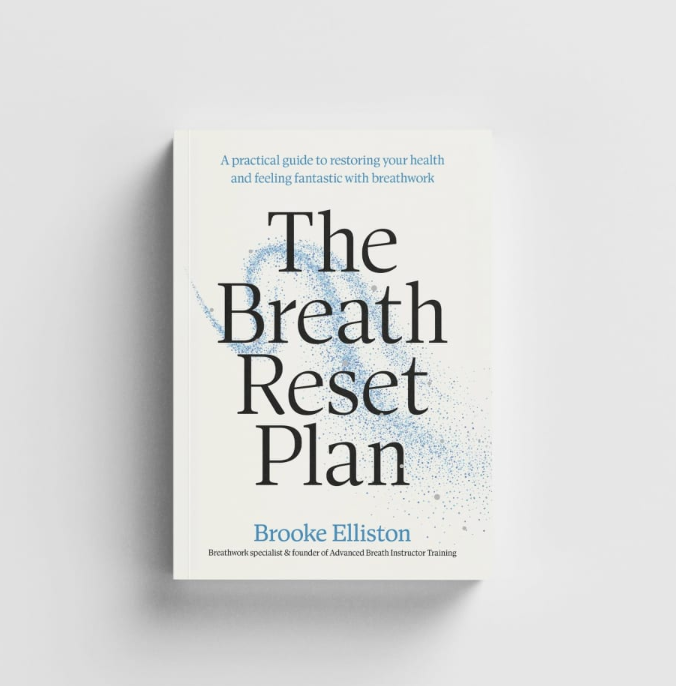
I wrote the breath Reset Plan because people are being taught how to breathe. They're given techniques and practices and methods. They're taught methods. But they're not being taught how to read their own breath and body - what I call being a Breath Detective. And this is so important, because is state-dependent and context-sensitive meaning we assume breath is a blanket input into a vacuum, but any technique is meeting a living system. What are your stress levels like? What is your sleep like? What is your training load right now, and have you been allowing adequate repair? What's your heart rate variability? All those tell me where your system is currently at and without knowing what the starting point is, without having some awareness of the physiological landscape in which a technique is landing, you really are guessing. There's no way of saying this technique equals that outcome for every single person. If you went to a gym trainer and said, “I want to get a six pack”, and the trainer said “sure, do 1000 crunches and cut carbs out for the next 2 years”, you’d be a bit baffled. And that would be unlikely. The trainer would be far more likely to first ask you, “have you ever been to the gym before? What is your history with exercise? What is your history with working out? What injuries do you have?”
You need to take into account the individual. And the book starts from here. And this leads me to the first pillar.
Awareness
Awareness of your breathing across different situations and contexts. How do you breathe at rest, yes, but also how do you breathe before, during, and after exercise? How do you breathe when you sleep? Because awareness of breathing gives you information about the current physiological landscape.
If you can learn to be a Breath Detective at a very simple, basic level for yourself, from there choices can be made with greater personalisation. That might include an input such as a breath practice that is titrated or personalised to you. But when I’m working with clients one on one, a lot of the time the first place we start is not even with a breath input. It might be looking at how to create a sleep routine, or how to help manage the load on someone’s' nervous system by moving exercise from nighttime to the morning. The focus stays on responding to the system as it is.
I really think this is different from most breath education and trainings, and this goes for yoga trainings as well, which often teach people, ‘here’s the list of techniques, and here’s the list of benefits and effects’. And it’s misguided. I think that’s why so many people try breathwork and it doesn’t make it to the top of their wellness list… because they don’t have the embodied experience of it being so effective that it’s genuinely life changing.
Awareness comes from the yogic teaching that breath is a diagnostic tool. The yogis believe that breath mirrors where your nervous system is at. It mirrors where your mind is at. That was always the message from the ancient texts. If your breath is unsteady, it reveals an unsteadiness in the mind, and so you use the breath to steady the mind. And in the Breath Reset Plan, we take this even further. You can use a whole toolbox of mind–body practices and routine shifts to create a solid foundation within the nervous system so that your capacity and window of tolerance expand.
In the book I also talk about fluidity in terms of shifting states with fluidity. And people might read that and think, “Oh, what I’m going to learn is how to shift into focus mode, how to increase my energy, how to shift to calm, and I’m just going to learn the right technique to do that.” Which is not the intention. What I teach is how to look at the current load on your system, how to gauge your window of tolerance using a range of validated assessments for both objective and subjective metrics, and with that awareness, how to titrate your inputs, whether that’s sleep, breath practices, emotional load, or cognitive load, so that capacity and window of tolerance expand. It’s basically saying, from where you are at, what’s the best way to resource your system.
And that’s the foundation of the ability to shift between states with ease. Imagine a dog that’s upbeat and energised one moment and then drops into deep rest the next. This flexibility emerges from capacity, not from manufacturing or imposing state changes on top of the body,
Connection
From awareness, we can begin to develop connection. There’s a big epidemic of disconnection between mind and body, which is woven into the essence of burnout. So many of us spend so much time up in our heads that we end up being ruled by the impulses or conditioning of the mind, and we miss the cues of the needs of the body, particularly for rest and recovery. That begins with developing interoception, which is the capacity to sense and feel signals from the body that affect our behaviour.
The thing about being in a stress state is that stress physiology condenses our perception by nature. When we’re in a stress state, we become hyper-focused, because the system is prioritising getting the job done. It’s like having tunnel vision. In stress, vagal tone is turned down. The vagus nerve is the primary nerve of the parasympathetic nervous system, and around eighty percent of its signalling is from body up to brain. When stress is dominant, that parasympathetic influence is reduced, and the more subtle signals coming from the body are harder to register clearly.
So first, our capacity to even hear what the body is saying is dimmed in stress. And secondly, many of us have been conditioned into a misread of otherwise benign body signals, like carbon dioxide or like our heartbeat, interpreting them as something anxiety- or panic-provoking rather than as neutral information.
Connection is both about sensing more of the signalling from body to brain, and fortifying signal clarity, so the nervous system isn’t reacting to false alarms or predicting that benign signals are “threatening” and something to be concerned about.

Sleep
Sleep is probably the biggest input to the nervous system when we think about load on the system and current baseline. If sleep isn’t good, it’s very hard for anything else to genuinely stick.
An example of this is when people describe themselves as light sleepers, as though it’s simply a personal trait. But at the nervous system level, light sleep usually reflects a system that predicts it needs to stay somewhat mobilised and on guard for threat. From an evolutionary perspective, that makes sense. If the body anticipates danger, it doesn’t fully stand down, and as a result it doesn’t enter the deeper stages of sleep where restoration happens.
Those deeper stages are where glymphatic clearance from the brain occurs, where immune repair is supported, and where emotional and cognitive experiences from the day are integrated. When sleep stays shallow or fragmented, that integration doesn’t happen fully. The emotional load of the day carries over, meaning you wake up still holding it, rather than starting from a more integrated and settled place.
I also pay close attention to signs of sleep-disordered breathing, because it’s one of the most underestimated sources of nervous system load. Some people assume they sleep well because they were unconscious for eight hours, yet their breathing, their airway, or how they feel in the morning tells a different story. Mouth breathing, subtle obstruction, or fragmented breathing during sleep can keep the nervous system in a state of vigilance all night long. Functionally, it’s similar to being in a chronic stress state at the nervous system level.
When airflow is disrupted, even subtly, small rises in carbon dioxide and dips in oxygen can trigger repeated micro-arousals. The person may not remember waking, but the nervous system is nudged toward wakefulness again and again. Over time, this keeps sympathetic tone elevated and makes regulation during the day much harder, because the system never fully drops into the stages where repair and recalibration occur.
This is why, in this work, sleep isn’t treated as something to optimise later, and breathwork isn’t used to compensate for a missing foundation. Sometimes the most supportive step is to address sleep first, to help optimise it, or to refer out for medical support, such as a sleep study, where conditions like sleep apnoea can be properly assessed.
Gut
Then we move on to the gut. And with the gut, it’s not that the way we breathe automatically fixes or improves digestion. It’s more that where the nervous system is at, and how our baseline breathing is, helps set up the internal environment the gut is operating within.
This is where things become visceral and chemical. Breathing helps set the backdrop of the internal environment through carbon dioxide, amongst other things, and when breathing becomes excessive or effortful, carbon dioxide drops and the chemical balance of the inner landscape shifts. I often describe this like changing the water quality in an aquarium. The fish haven’t changed, yet everything becomes more reactive because the conditions have changed.
The gut is continuously reporting inward to the brain through the nervous system. When that internal environment is inflamed, irritated, or unbalanced, such as in gut dysbiosis, the information arriving upstairs carries more urgency. The brain reads this as context. Is this an environment where digestion feels accessible and can be prioritised, or is this an environment the system needs to pay attention to, in which case digestion is deprioritised?
Over time, that internal “noise”, as it’s referred to in neuroscience, can influence mood, energy levels and stress tolerance without any obvious external trigger, because the nervous system is responding to chemistry and sensation from within. Breathing is part of establishing a healthier internal environment for the system to function within, because the regulation of breathing chemistry influences the conditions that many other physiological systems respond to. Digestion, like other systems in the body, takes cues from this internal environment to gauge the appropriate level of response.
When breathing supports a more stable internal state, that environment is more likely to signal safety to the brain, and digestion becomes more accessible. It’s also why digestive issues such as constipation, bloating, diarrhoea, and IBS are so commonly seen alongside dysfunctional breathing patterns. They tend to go hand in hand.
Movement
The last pillar is movement. Often, when we talk about movement from a breathing perspective, the conversation quickly goes toward exercise performance and optimisation. How do we perform better, how do we get more out of training. That’s far less my focus. I’m much more interested in freedom of movement and freedom of embodiment.
There is often a rigidity in how people move and express themselves. And when there is mind–body disconnection, you can see it quite clearly. Imagine the person at an ecstatic dance standing in the corner feeling deeply uncomfortable. I know it might seem like not everyone should be dancing wildly, but it does reflect a level of comfort within one’s own body. Usually it’s someone who has spent very little time inhabiting their body, or feeling safe connecting to it.
This is where breathing patterns become visible. I might assess someone’s breathing, and for a novice, someone just starting to become a breath detective, they might think there’s not much to see. They’re not dramatically chest breathing, they’re not gasping or sighing. But what’s often missed is the rigidity. There is a holding and a level of control that has been conditioned from the mind down.
This is actually how the book begins. I talk about being poised and composed, about people telling me that I was calm and chill. But in reality, anxiety was sitting beneath that mind–body disconnection, and as a result there wasn’t freedom of expression in my body.
I also share a story in the book about being in Ghana and learning traditional African dance. One of the teachers said to me, “You dance like you do sport.” At the time, it was frustrating to hear and hard to grasp. Later, it made perfect sense.
I was moving with high-intensity breathing, high in the chest, fast and effortful, the kind of breathing that suits high-intensity training, and that also matched my personality as someone who exercised constantly as a form of regulation.
Not long after that, I was hospitalised, and eventually learned that I had chronic hyperventilation. Looking back, the way I moved, the way I held myself, and even the way I danced were all reflected through that same “sports” breathing pattern.
This is the part people often miss, because dysfunction can hide behind competence. Someone can appear put together while living with a level of rigidity that leaves very little freedom or variability. You see it in a dance room when someone stands in the corner looking fine, yet the idea of letting movement arise feels unsafe or unfamiliar.
As breathing begins to support connection rather than readiness, movement often becomes something the nervous system “allows” without being taught. The same goes for rest. The nervous system allows rest because it feels safe, rather than relaxation being something we do.
End
When you use the pillars together, you become a breath detective in the best sense. You start to see what’s driving your state and what kind of support will actually restore balance. That’s when people develop real fluency, because they’re no longer relying on a band-aid technique to create a temporary feeling or state-change. They’re resourcing the system so that all states - from energy, recovery, repair, and focus and beyond, can emerge when they’re required for the moment.